Retinol purging or a breakout: how to tell
How to sort a retinol purge from a breakout or irritation: timing, where it shows up, and when to stop or see a dermatologist.
Key points
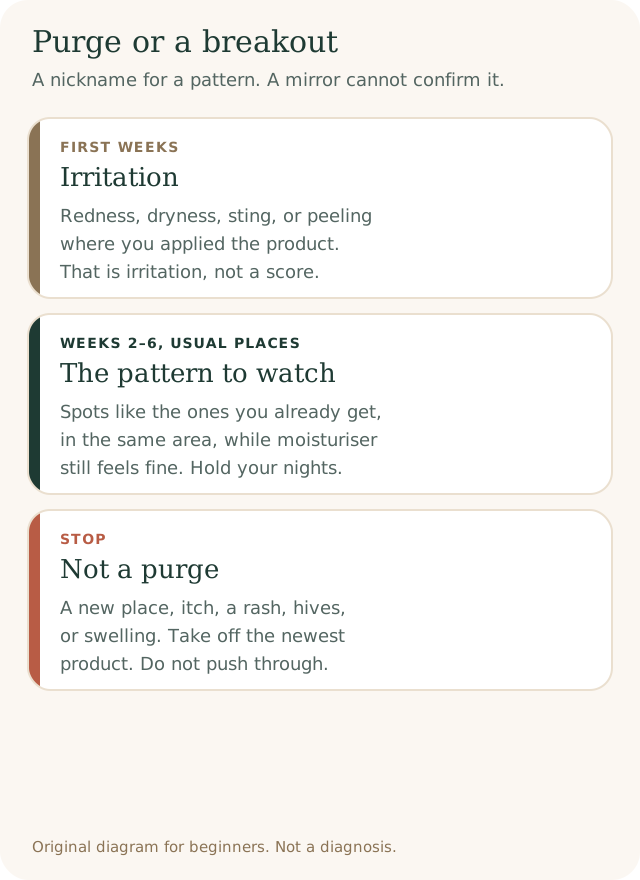
- A purge is a nickname. A mirror cannot confirm it.
- Redness, dryness, sting, or peeling where you applied it is irritation.
- Spots like yours, in the same area, in the early weeks: hold your nights.
- A new place, itch, a rash, hives, or swelling means stop.
- Cosmetic retinol is not an acne medicine.
The same check is the free purge or irritation page and the purge or breakout guide. Night count is in the start plan.
Two changes, one nickname
- Irritation is redness, itch, dryness, burning, scaling, or peeling where you applied the product. DermNet calls that retinoid dermatitis: erythema, peeling, and dry skin, plus irritant contact dermatitis, sun sensitivity, and rare allergic contact dermatitis.
- More acne spots is a different sentence. It belongs to acne retinoids, especially adapalene.
The American Academy of Dermatology describes retinol as over-the-counter vitamin A for uneven tone, pigmentation, and texture. Adapalene is the non-prescription retinoid it names for acne. Tretinoin, tazarotene, and trifarotene are prescription. A serum labeled retinol is not that gel.
What the acne labels say about new spots
DailyMed's non-prescription adapalene 0.1% facts say acne may look worse in the early weeks before it improves. For that gel, the label calls this expected and says to continue unless irritation becomes severe.
Prescription labeling says the early exacerbation is the medicine acting on previously unseen lesions, and that this alone is not a reason to stop. Look for results after eight to twelve weeks: spots already forming, not a cosmetic-retinol result.
That prescription label also lists acne flares among effects reported in approximately 1 percent or less of patients, mostly in the first month. Erythema, scaling, dryness, pruritus, and burning occur in 10 to 40 percent.
Both lines are on one label, so "purge" does not mean most people get a flare.
A 2009 review in the Journal of Drugs in Dermatology looked for trials showing that topical retinoids worsen acne at the start. Its abstract says no primary trial data were found for that idea, and that the data found pointed to improvement even in the first couple of weeks. Worse acne in the first week or two, it says, can be acne's own course.
A 2008 discussion of three phase 3 trials defined a flare as at least a 10 percent rise in inflammatory lesions at week 2. Most people improved. In mild acne, tretinoin 0.025 percent gel alone was 15.4 percent, against 8.7 percent on the empty gel. That gap did not show in moderate or severe acne, and a clindamycin-plus-tretinoin gel did not flare there.
Timing
- Prescription adapalene labeling puts erythema, dryness, scaling, burning, or pruritus mostly in the first two to four weeks, usually easing if you continue.
- The non-prescription leaflet puts redness, itching, dryness, and burning in the first few weeks, usually easing after four weeks of continued use.
- A second topical acne medicine, a scrubbing cleanser, or a drying product makes that irritation more likely.
- Apparent worsening of acne, on those pages, is an early-weeks event, not a surprise in month four of a quiet routine.
The non-prescription label allows up to three months of once-daily use, then a doctor if nothing has improved. The Academy says fewer breakouts are a six-to-eight-week mark at the earliest, some improvement shows at four to six weeks, and the longer view is two to three months. DermNet says an acne retinoid may need twelve weeks or longer. A cosmetic retinol is not on that clock.
Where it shows up
Non-prescription adapalene goes on as a thin layer over the whole affected area, the whole face if that is where the acne is, not one spot.
- Keep it off eyes, lips, the angles of the nose, and mucous membranes.
- Keep it off cuts, abrasions, eczema, and sunburn.
- Flush with water if it lands in the eyes, lips, or mouth.
- DermNet notes it can sting beside the eyes or lips.
"Previously unseen lesions" means acne already forming where you are treating. It does not mean an itchy sheet on the eyelids, a rash outside the area you used, or swollen lips. Perioral dermatitis and folliculitis can mimic acne.
On darker skin, the Academy's retinoid page says irritation can leave dark marks, and that a slow start with moisturiser lowers that chance. A brown patch after a raw week is not a purge. Widespread redness is a reason to skip retinoids and ask a dermatologist, including about rosacea.
Three questions, not a diagnosis
On adapalene, follow the label and stop if irritation is severe. On cosmetic retinol, use three questions.
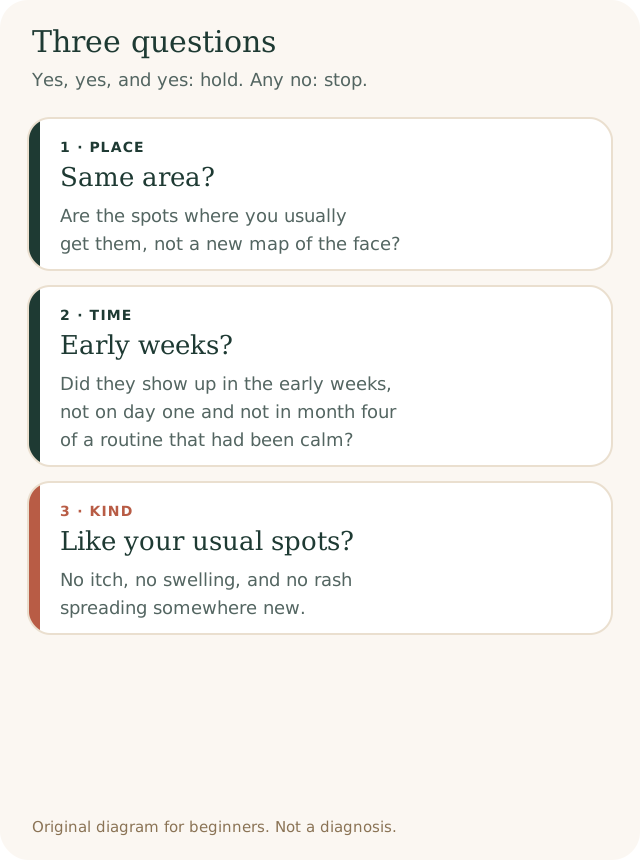
- Are the spots where you usually get them?
- Did they show up in the early weeks, rather than on day one or after months of calm use?
- Do they look like your usual spots, without itch, swelling, or a rash spreading to new areas?
If yes, yes, and yes, hold the frequency and change nothing else for two weeks. If any answer is no, stop the newest active and do not call it a purge. Note the date, the product, the nights, the place, and whether moisturiser stings.
What to change while you watch
For a retinoid a dermatologist directs, the Academy suggests less product, less often, and moisturiser first if it is strong.
- Extra adapalene will not work faster and can irritate more. Moisturiser is allowed.
- Skip alpha hydroxy and glycolic acids. The non-prescription leaflet says they can worsen irritation.
- Do not scrub. The Academy says scrubbing can make acne-prone skin worse, and that a new acne product every few days can irritate and cause breakouts.
- If an acid, a scrub, and a retinoid started in the same fortnight, drop the extras.
- Limit sun, including tanning beds, as adapalene labeling says. Use the retinoid at night, with shade, clothing, and broad-spectrum, water-resistant SPF 30 or higher.
- DermNet pairs night use with a daytime sunscreen and moisturiser. Wind and cold can irritate skin on adapalene. After a sunburn, wait, including for a cosmetic retinol.
Raw skin, or a plain moisturiser that still stings the next morning, means stop. Use the reset guide: cleanser, moisturiser, sunscreen. Restart the start plan only when that routine feels ordinary.
When to stop or ask
- Stop and ask a doctor if irritation is severe or overly bothersome, and ask again before restarting.
- Prescription labeling says to stop when a reaction suggests sensitivity or chemical irritation, or to apply less often.
- Urgent care is the allergic list on the non-prescription label: itching, rash, hives, swelling of the lips or eyelids, or shortness of breath.
- See a dermatologist for deep cysts or nodules, for acne that has not improved on a non-prescription product, or because the acne bothers you. A dermatologist can tell acne from a lookalike.
- Blisters, oozing, a spreading rash, or eyes involved belong in that visit, or with a pharmacist the same day. Do not restart while a simple routine is still unsettled.
Bought retinol because of breakouts? Ask about a product made for acne, adapalene included where it is sold freely, and follow that label. Do not layer it with a cosmetic retinol.
Pregnancy, and a prescription you already have
Elsewhere on this site, you wait through pregnancy, trying to conceive, and breastfeeding. The Academy says not to use retinoids in pregnancy. Non-prescription adapalene says to ask a doctor if you are pregnant or breastfeeding, and to stop if you become pregnant or start planning to. DermNet says some topical retinoids are contraindicated in pregnancy, absorption through skin is limited, and contraception still matters because retinoids can be teratogenic. Ask a doctor, midwife, or pharmacist what to use instead.
A retinoid or oral isotretinoin from a prescriber stays under that prescriber. Do not add cosmetic retinol on top of it.
Watch, then the longer map
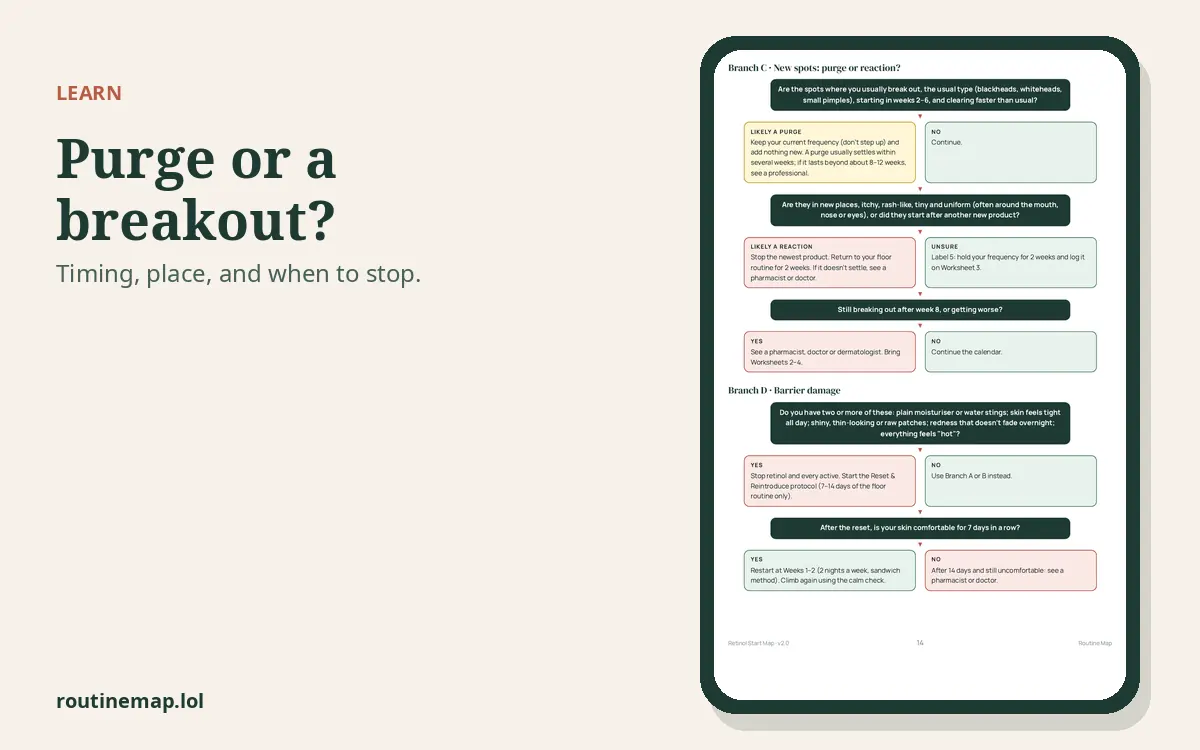
The paid Retinol Start Map is the 12-week schedule, a purge-or-reaction flowchart, and worksheets, at $9.99. The Retinol + Reset Bundle is both guides at $14.99. It does not rank products or link to shops.
Further reading
Sources
- Adapalene gel USP, 0.1% (non-prescription drug facts) — DailyMed, U.S. National Library of Medicine, 2026
- Adapalene gel, 0.1% (prescription labeling) — DailyMed, U.S. National Library of Medicine, 2018
- Do topical retinoids cause acne to 'flare'? — Journal of Drugs in Dermatology, 2009
- Retinoid-induced flaring in patients with acne vulgaris: does it really exist? — Journal of Clinical and Aesthetic Dermatology (via PubMed Central), 2008
- Topical retinoids — DermNet, 2021
- Retinoid or retinol? — American Academy of Dermatology, 2021
- Acne: Diagnosis and treatment — American Academy of Dermatology, 2024
- 9 things to try when acne won't clear — American Academy of Dermatology, 2023
Last reviewed 26 October 2026
Educational only. Not medical advice. Patch test a new product and follow its label. See a dermatologist for irritation that persists, for raw skin, or for a problem that is not settling.