How to start retinol: a week-by-week plan
A calm week-by-week retinol start: two or three nights, a pea-sized amount, buffering, irritation, daily SPF, pregnancy, and the EU 0.3% cap.
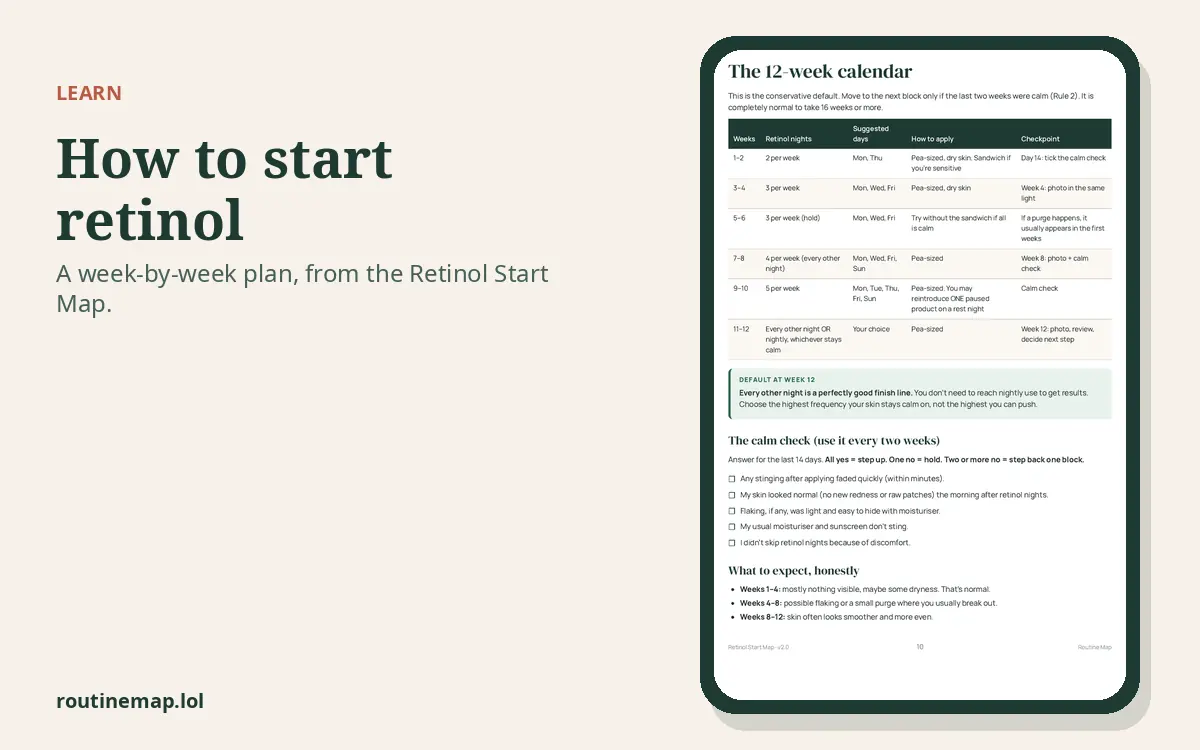
"Start slow" is not a calendar. This is the week-by-week plan Routine Map uses, the same idea as the free retinol guide: two nights in the first fortnight, a pea-sized amount, moisturiser as a buffer, and a step up only after two calm weeks. It is educational, not a prescription or a diagnosis.
A calm week means your usual moisturiser does not sting, your skin is not tight all day, and you do not have raw patches. Mild dryness that settles with a richer moisturiser can still count. Stinging that is still there the next morning does not.
What retinol is
Retinol is a form of vitamin A. Retinaldehyde, retinoic acid, and the esters retinyl acetate and retinyl palmitate sit in the same family. Skin does not use retinol as-is. A 2006 review describes the conversion: retinol is oxidised to retinaldehyde, then to retinoic acid, the form that binds nuclear receptors. The same review reports that retinol has to make that conversion before it acts, and that it is about twenty times less potent than tretinoin, the prescription acid. That gap is why a cosmetic retinol is the usual first bottle.
The American Academy of Dermatology describes retinoids as vitamin A products. It describes retinol as the over-the-counter member, used for uneven tone, pigmentation, and texture. Tretinoin, tazarotene, trifarotene, and oral isotretinoin are medicines. If you already use one, your prescriber leads. Do not add a cosmetic retinol on top.
The review also notes that retinol breaks down in light and air, which is why this plan keeps it for the night.
Two or three nights, a pea, and a buffer
Weeks 1 and 2 are two retinol nights. Monday and Thursday is an easy pattern. Other nights are rest nights: cleanse, moisturise, no active. An Academy note from October 2022 says a retinoid every night from the start can leave skin excessively irritated, red, and dry, and suggests two or three times a week for a couple of weeks, then more often only if that is calm. Its retinoid page says to begin with the least intense formula, every other night. Two nights is the Routine Map default. Three nights is fine if two already feels quiet. Neither is a finish line.
Step up only after two calm weeks, by one retinol night, not by a stronger bottle or a larger blob. If that frequency is calm for two more weeks, you may step up again. If a week is not calm, go back to the last calm frequency until you have two calm weeks. Staying at two nights for twelve weeks is a valid result.
Use a pea for the whole face. Dot the forehead, cheeks, and chin, then spread. The Academy's acne guidance lists a smaller amount as one way to limit retinoid irritation, and says more product than directed does not make a topical faster. Skip eyelid margins and the creases by the nose and lips.
Buffer the first weeks. Those same tips include moisturiser before a stronger retinoid, and moisturiser while you start slowly. The version here is the sandwich, on dry skin: moisturiser, the pea of retinol, moisturiser again. Damp skin can sharpen a sting. A sting that fades in about ten minutes, with an ordinary morning, is often adjustment. Keep the sandwich until two calm weeks at that frequency.
Morning stays put: gentle cleanse, moisturiser, sunscreen of SPF 30 or higher, sunscreen last. One new active at a time.
Irritation in the first weeks
The 2006 review calls the usual early pattern a retinoid reaction: itch, burning, redness, and peeling, generally in the first few weeks, and more common with tretinoin than with retinol. Retinol is not exempt. DermNet describes the same cluster as retinoid dermatitis, including dryness and sun sensitivity.
Do not scrub flakes or add another active. Light flaking and a calm morning mean a richer moisturiser, same frequency. Stinging moisturiser, all-day tightness, or raw patches mean stop and reset for 7 to 14 days: cleanser, moisturiser, sunscreen. That protocol is the reset guide. Blisters, oozing, swelling, eyes involved, or no change after 14 days of it are reasons to see a pharmacist or a doctor.
Spots in the usual places in weeks 2 to 6 can be a purge. Hold the frequency. Spots in new places, or a rash, mean stop the newest product. Cosmetic retinol is not an acne medicine. For clogged pores, ask about adapalene or another option made for that.
Pause exfoliating acids
For the first eight weeks, pause acids, scrubs, peels, and any other retinoid. Toners, pads, acid serums, and grainy scrubs count. The free guide uses the same window. The reaction shows up early, and a second irritant is how a calm week turns raw. If an active is new in the last two weeks, or you already use two exfoliants, take two quiet weeks before night one, then start at week 1. After week 8, one exfoliant night a week at most, never beside retinol.
Vitamin C can stay in the morning. Niacinamide in a moisturiser is usually fine. If something stings, drop the newest product. Benzoyl peroxide, if you use it, stays in the morning, not layered with retinol.
Night, then sunscreen every morning
Use retinol at night. The Academy says to apply a retinoid only at night because it can increase sun sensitivity, and to cover daytime skin with shade, clothing, and sunscreen. Its pores page says to apply retinol or retinyl palmitate before bed. DermNet pairs night use with daytime sunscreen for that sensitivity.
Make sunscreen a habit before night one if it is not one already: broad-spectrum, water-resistant, SPF 30 or higher, including rain and cold, and reapplied the way the bottle says when you are outside for long. After a sunburn, skip retinol until the skin is calm, then restart at week 1.
Pregnancy, trying to conceive, breastfeeding
Do not start a retinoid, including an over-the-counter retinol, if you are pregnant, trying to conceive, or breastfeeding. That is the rule on the rest of this site, and it is the rule here.
The Academy's retinoid page says not to use retinoids in pregnancy. Its pores page names the cosmetics: no retinol or retinyl palmitate in pregnancy or while breastfeeding. MotherToBaby's July 2024 sheet is about prescription topical tretinoin, a different bottle. It says some tretinoin can still be absorbed, so avoiding it for the whole pregnancy is the safer course, and that stopping about a month before trying to conceive follows the advice given for oral isotretinoin. On breastfeeding it says topical tretinoin has not been studied, very little is expected in milk, and the question belongs with your clinician. This plan does not split those cases. You wait. Cleanser, moisturiser, and sunscreen are a full routine until then. Ask a doctor, midwife, or pharmacist what to use instead.
Under 18, that same three-step routine is enough for most skin. A cosmetic retinol "for lines" can wait. Breakouts are a reason to ask a pharmacist or a doctor.
What 8–12 weeks and 3–6 months mean
Do not score the bottle in week 2. Week 2 is still adjustment.
The 2006 review cites a controlled retinol trial with a significant improvement in fine wrinkles after 12 weeks, and tretinoin trials in which fine wrinkles and roughness improved across about 3 to 6 months. DermNet says an acne retinoid may need 12 weeks or longer, and that tretinoin used beyond 6 months can reduce fine wrinkling. The Academy says an acne plan often needs at least 6 to 8 weeks before fewer breakouts. Retinol is less potent than tretinoin, so Routine Map reads those windows as a texture check around 8 to 12 weeks and a fine-line check around 3 to 6 months. They are windows, not a guarantee, and not a reason to raise the percentage because a date arrived. Tolerating two or three nights at week 12, without raw skin, means the schedule is working.
The EU 0.3% and 0.05% caps
Commission Regulation (EU) 2024/996 restricts retinol, retinyl acetate, and retinyl palmitate. Body lotion is capped at 0.05% retinol equivalent. Other leave-on and rinse-off products, including a face product, are capped at 0.3%. The label has to say the product contains vitamin A and to consider your daily intake before use. From 1 November 2025, non-compliant products may not be placed on the Union market. From 1 May 2027, they may not be made available there.
0.3% is a ceiling, not a goal. Do not spread a face percentage over the body. The annex does not name retinaldehyde, and a retinal serum can still be too much in week 1. The United Kingdom and the United States are outside this rule. The EU guide goes through the dates.
The paid Retinol Start Map is this schedule with one page per week, five flowcharts, and worksheets. This article is the free version. It does not rank products or link to shops.
Sources
- Retinoids in the treatment of skin aging: an overview of clinical efficacy and safety — Clinical Interventions in Aging (via PubMed Central), 2006
- Retinoid or retinol? — American Academy of Dermatology, 2021
- National Healthy Skin Month: dermatologists provide tips on caring for your skin, hair, and nails — American Academy of Dermatology, 2022
- Acne: Diagnosis and treatment — American Academy of Dermatology, 2024
- What can treat large facial pores? — American Academy of Dermatology, 2026
- Topical retinoids — DermNet, 2021
- Topical Tretinoin — MotherToBaby, 2024
- Commission Regulation (EU) 2024/996 — EUR-Lex, 2024
Last reviewed 23 October 2026
Educational only. Not medical advice. Patch test a new product and follow its label. See a dermatologist for irritation that persists, for raw skin, or for a problem that is not settling.